DESK FEATURE
Where Water Meets Memory: The River Culture of Japan
Japan is a land of steep mountains and short, fast rivers. Rain and snowmelt tumble from the central ranges to the sea within a few days, carving valleys, feeding rice paddies and, from time to time, flooding towns. For more than two thousand years this restless water has shaped not only the country’s geography but also its beliefs, food, festivals and art. To follow a Japanese river from source to estuary is to travel through the nation’s cultural history.
Rivers as Gods and Boundaries
In the Shinto worldview, natural features are home to kami, and rivers are no exception. Shrines stand at sources, confluences and waterfalls, and many villages hold rituals to thank the river for irrigation or to calm it before the flood season. The act of purification, or misogi, in which worshippers wash away impurity in flowing water, remains a basic spiritual practice. Even the small stone basin at a shrine entrance, where visitors rinse their hands, echoes this ancient link between water and cleanliness.
Rivers also served as natural borders. Provinces were frequently defined by river lines, and crossing points became sites of checkpoints, markets and inns. Several of Japan’s rivers have names that reflect these roles, and many appear in poetry as symbols of time, change and separation.
Taming the Flood
Because Japan’s rivers can swell quickly, flood control became one of the earliest tasks of local rulers. Embankments, spillways and planted bamboo groves were developed over centuries. Famous engineering feats include the work of regional lords such as Takeda Shingen, whose levee system on the Kamanashi River in the sixteenth century is still studied for its design. In the Edo period, the shogunate redirected rivers around the capital, reshaping the landscape and creating the waterways on which the city’s commerce depended.
This long struggle left a distinctive cultural mark. Communities organised themselves around shared responsibility for dikes, and traditions of mutual aid arose from the demand to repair them. Memorial stones along riverbanks honour flood victims and the engineers who sought to prevent more tragedy, reminding residents of the double nature of water as giver and destroyer.
Rice, Irrigation and the Village
Rivers made Japanese rice agriculture possible. Elaborate irrigation networks channelled water into terraced paddies, and the distribution of water was carefully negotiated among villages. Disputes over water rights were common, and rituals such as rain-praying dances and festivals evolved to ask the gods for a stable supply.
The seasonal rhythms of rice farming are still visible in many river valleys, where paddies shimmer in early summer and golden stalks are harvested in autumn. In some regions, local customs link the river’s behaviour to the agricultural calendar, from the first snowmelt to the autumn typhoons.
Fishing Traditions: The Ukai of the Nagara
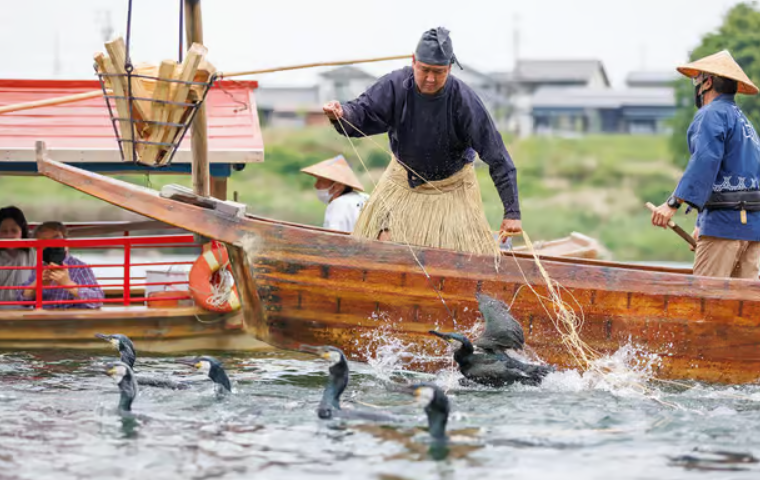
Few river customs are as striking as ukai, or cormorant fishing, which has been practised for roughly 1,300 years. On the Nagara River in Gifu Prefecture, fishermen in wooden boats guide trained cormorants at night, using flaming braziers to lure fish toward the surface. The birds, tethered with light cords, dive and catch fish, which the usho, or master, retrieves. The practice was once patronised by shoguns and is still carried out under the supervision of the Imperial Household Agency, whose officials hold the title of imperial cormorant masters.
Today, visitors board viewing boats to watch the spectacle, with firelight dancing across the water. The tradition survives as both a tourist attraction and a living craft, passed from fathers to sons. It is also a rare example of a working partnership between people and animals that has endured with little change.
River fishing more broadly gave rise to a distinct cuisine. Ayu, a sweet river fish sometimes called “sweetfish,” is grilled with salt on skewers and prized in summer. Eel from rivers and lakes is another celebrated delicacy, and regional dishes cooked with freshwater fish still feature in mountain towns.
Summer on the Riverbank
Rivers are social spaces as well as sources of food. In Kyoto, restaurants along the Kamo River build raised wooden platforms, called yuka or noryo-yuka, in the warm months. Diners eat kaiseki meals while the breeze and water sounds provide natural air conditioning. The custom dates back several centuries, and the platforms appear each May through September.
Fireworks festivals, or hanabi taikai, are another beloved riverside event. The Sumida River Fireworks in Tokyo trace their roots to the eighteenth century, when they were held to pray for the dead after famine and disease. Families gather along the banks in yukata, eating shaved ice and watching colourful bursts reflect in the water. Many towns hold similar events each July and August.
Lanterns, Spirits and Rivers of Memory
Rivers also connect the living with the dead. During Obon, floating paper lanterns, called tōrō nagashi, are set on rivers to guide ancestral spirits back to the other world. In Hiroshima, lanterns float on the Motoyasu River each August 6 in memory of atomic bomb victims, transforming the water into a place of quiet reflection and peace.
This symbolic use of rivers appears in classical literature as well. Poets of the Heian court used images of flowing water to express the impermanence of life, a theme echoed in the famous opening of the medieval work Hōjōki, which compares human existence to a river whose water never stays the same.
Art and Poetry of the River
Japanese artists have long depicted rivers in painting and prints. Woodblock masters such as Hokusai and Hiroshige portrayed scenes along the Sumida, Tama and Kiso Rivers, capturing ferries, bridges, travellers and changing weather. Bridges, such as Nihonbashi in Edo, served as starting points for the great highways and became subjects in their own right.
Modern writers and filmmakers have continued the tradition. River landscapes appear as backdrops for stories of nostalgia, childhood and rural life, and anime films have likewise used riverbanks as settings of memory and longing.
Modern Challenges and Renewal
Postwar development changed many of Japan’s rivers. Concrete embankments, dams and straightened channels protected cities but also cut communities off from the water and harmed ecosystems. Pollution during the era of rapid industrialisation made some rivers unfit for life.
In recent decades, a movement to restore river environments has gained ground. Cities have removed concrete, created riverside parks and reintroduced native species. Community groups clean banks, school children study local waterways and festivals revive old traditions. Climate change and heavier rain add urgency, as authorities seek ways to combine flood protection with ecological and cultural values.
Japan’s river culture is a story of reverence, struggle and celebration. Rivers have been worshipped as gods, feared as destroyers, harnessed for rice and enjoyed as places of beauty and gathering. Their presence echoes in rituals, food, festivals and verse. As Japan adapts to a changing climate and a changing society, the challenge is to preserve this relationship, ensuring that people continue to listen to the rivers that have shaped them.